Your Blood Vessels Are Aging in Silence: The Endothelial Crisis Most Americans Never See Coming

Photo: Nadav Spiegelman, CC BY-SA 4.0, via Wikimedia Commons
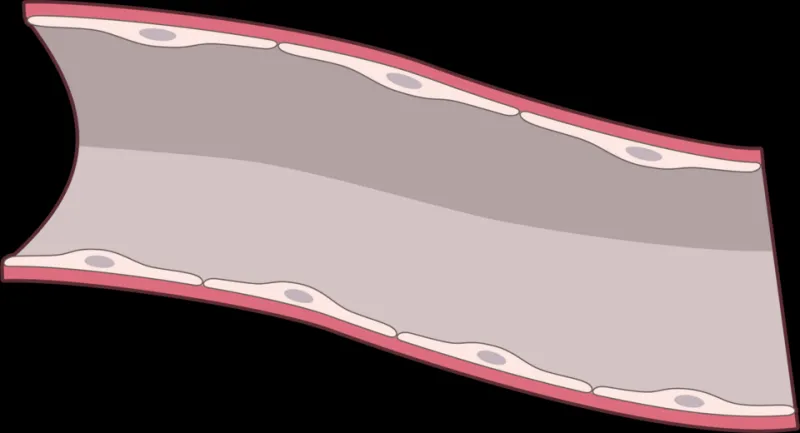
Most Americans spend considerable time and money protecting the surface of their skin from aging — SPF formulas, retinoids, antioxidant serums. Yet beneath every inch of that carefully tended skin runs a network of blood vessels whose inner lining is aging at a rate that no topical product can address. This lining — a single-cell-thick layer called the endothelium — may be the most important tissue in the human body that virtually no one outside of cardiology circles thinks about. And for millions of people across the country, it is already failing.
The endothelium is not simply a passive barrier. It is a living, metabolically active organ that regulates blood pressure, governs clotting responses, controls inflammation, and orchestrates the delivery of oxygen and nutrients to every tissue in the body. When it functions well, circulation is fluid, responsive, and efficient. When it begins to deteriorate — a condition clinicians refer to as endothelial dysfunction — the consequences unfold slowly, invisibly, and often catastrophically.
What the Endothelium Actually Does
To appreciate the scale of endothelial dysfunction, consider the anatomy first. If you were to unfold and lay flat the endothelial cells lining the blood vessels of a single adult human, they would cover an area roughly equivalent to six tennis courts. This vast surface is in constant communication with your blood, your immune system, and your nervous system simultaneously.
Among its most critical responsibilities is the production of nitric oxide, a signaling molecule that keeps vessel walls relaxed and pliable. Nitric oxide prevents platelets from clustering inappropriately, reduces oxidative stress along the vessel wall, and maintains the elasticity that allows arteries to expand and contract with each heartbeat. A healthy endothelium essentially acts as a dynamic buffer between the mechanical forces of circulation and the delicate tissues they serve.
Endothelial dysfunction disrupts this entire regulatory cascade. The vessel wall becomes stiffer, less responsive, and more prone to inflammation. Blood flow becomes turbulent in places it should be smooth. Platelets begin to aggregate where they should not. And the stage is set for outcomes that range from chronic fatigue and cognitive fog to heart attack and stroke.
The Daily Habits Quietly Destroying Your Vessel Lining
What makes endothelial dysfunction so insidious is that it is largely self-inflicted — not through dramatic choices, but through the accumulated weight of ordinary American habits.
Dietary patterns represent one of the most potent drivers. Diets high in refined carbohydrates and ultra-processed foods generate persistent spikes in blood glucose and insulin. These metabolic fluctuations trigger oxidative stress directly at the endothelial surface, impairing nitric oxide synthesis and accelerating cellular senescence within the vessel wall. Research has consistently shown that even short-term exposure to hyperglycemia measurably reduces endothelial function in otherwise healthy adults.
Chronic psychological stress is equally damaging, though far less discussed in this context. Sustained elevation of cortisol and catecholamines promotes a pro-inflammatory state that the endothelium absorbs with every passing hour. The sympathetic nervous system, when chronically activated, increases vascular resistance and reduces the shear stress patterns that normally stimulate beneficial nitric oxide release. In a country where workplace stress, financial pressure, and digital overstimulation have become baseline conditions for tens of millions of adults, the vascular toll is significant.
Sedentary behavior compounds both of these factors. Regular physical movement generates the kind of rhythmic blood flow that mechanically stimulates endothelial nitric oxide production. When that movement disappears — as it has for large segments of the American workforce — the endothelium loses one of its primary maintenance signals.
Poor sleep quality deserves particular mention. During deep sleep, blood pressure drops and the vascular system undergoes a nightly repair cycle. Disrupted or insufficient sleep interrupts this process, leaving endothelial cells in a state of sustained low-grade injury. Studies tracking sleep duration and endothelial function have found measurable impairment in individuals sleeping fewer than six hours per night, independent of other cardiovascular risk factors.
Biomarkers That Reveal What Is Happening Inside Your Vessels
One of the challenges of endothelial dysfunction is that standard lipid panels and blood pressure readings often appear normal until the condition is quite advanced. However, several more specific markers can offer earlier insight.
Flow-mediated dilation (FMD) is considered the gold standard for assessing endothelial function non-invasively. It measures the percentage by which an artery widens in response to increased blood flow — a process entirely dependent on nitric oxide availability. Reduced FMD scores are associated with elevated cardiovascular risk years before traditional markers become abnormal.
High-sensitivity C-reactive protein (hs-CRP) reflects systemic inflammation and correlates strongly with endothelial injury. Levels above 2.0 mg/L, even in the absence of acute illness, suggest ongoing vascular inflammation.
Asymmetric dimethylarginine (ADMA) is a naturally occurring compound that inhibits nitric oxide synthesis. Elevated plasma ADMA is one of the most direct indicators of endothelial compromise available through specialized laboratory testing.
Homocysteine levels, when elevated, exert direct toxic effects on endothelial cells and are associated with accelerated vascular aging. This marker is frequently overlooked in routine wellness panels despite its clinical relevance.
If any of these markers are outside optimal ranges, they represent not a death sentence but a signal — one that the body is offering before irreversible structural changes have taken hold.
Strategies That Support Endothelial Repair and Resilience
The endothelium possesses a meaningful capacity for renewal when the conditions that support it are restored. The following approaches have demonstrated evidence-based benefit in clinical and observational research.
Dietary nitrate consumption from sources such as dark leafy greens, beets, and arugula provides substrate for the nitric oxide pathway through a mechanism independent of endothelial enzyme function. This matters because it can partially bypass the impaired synthesis that characterizes dysfunctional endothelium.
Aerobic exercise, performed consistently at moderate intensity, is among the most potent endothelial interventions available. Even thirty minutes of brisk walking five days per week has been shown to improve FMD scores and reduce circulating inflammatory markers within weeks of initiation.
Polyphenol-rich foods — including dark berries, green tea, and extra virgin olive oil — contain compounds that activate endothelial nitric oxide synthase and reduce oxidative stress along the vessel wall. Their protective effects are cumulative and diet-pattern dependent rather than tied to any single meal.
Targeted nutritional support through evidence-informed supplementation may also play a role in maintaining endothelial integrity, particularly for individuals whose dietary patterns, stress levels, or metabolic history have placed their vessel health at greater risk. Supporting the biochemical pathways that underpin nitric oxide production and vascular flexibility is central to the philosophy behind blood health optimization.
Sleep hygiene interventions — consistent sleep schedules, reduced blue light exposure in the evening, and management of sleep-disrupting stressors — restore the nightly vascular repair cycle that the endothelium depends upon.
The Vessels You Cannot See Deserve the Same Attention as the Skin You Can
Premature vascular aging does not announce itself with the same visibility as a wrinkle or a gray hair. It accumulates in silence, measured in the subtle stiffening of arterial walls, the gradual impairment of blood flow to the brain and heart, and the slow erosion of the body's capacity to regulate itself. By the time most Americans receive a cardiovascular diagnosis, the endothelial damage has been building for a decade or more.
The opportunity — and it is a genuine one — lies in recognizing the endothelium as a target of active, deliberate care rather than an afterthought. The same commitment to nourishing the body from the outside can and should be directed inward, toward the vessel walls that determine how well every organ in the body is supplied, supported, and sustained. Your blood's health begins at the wall it travels through. Protecting that wall is not optional — it is foundational.